Psychedelics
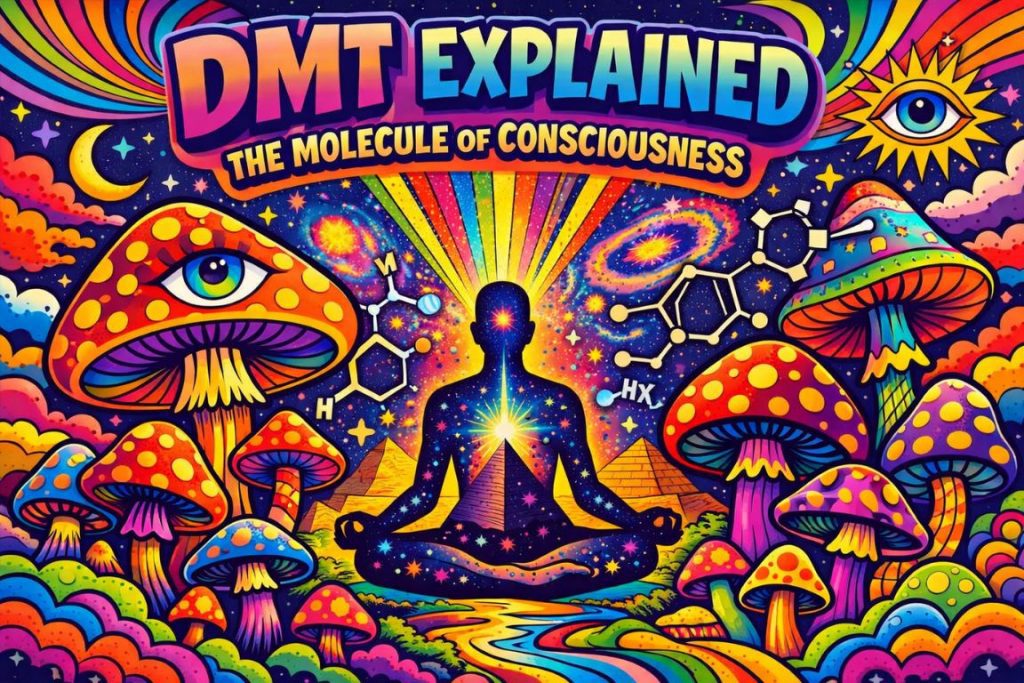
DMT Explained: The Molecule of Consciousness
Aug
DMT, short for N,N-Dimethyltryptamine, is one of the most powerful and widely discussed psychedelic compounds in modern research. Often referred to as the “molecule of consciousness,” DMT has drawn scientific interest because of the profound changes in perception and awareness it can produce in very short timeframes.
While cultural narratives around DMT are expansive, modern research focuses on what it is, how it interacts with the brain, and why scientists are studying it.
What Is DMT?
DMT is a naturally occurring psychedelic compound found in certain plants and trace amounts in mammals. It belongs to a broader class of compounds called tryptamines, which interact with serotonin receptors in the brain.
According to research summarized by the National Center for Biotechnology Information (NCBI), DMT has a chemical structure similar to serotonin, a neurotransmitter involved in mood, perception, and cognition.
🔗 https://www.ncbi.nlm.nih.gov/pmc/articles/PMC6088236/
This similarity is central to how DMT affects consciousness.
Why It’s Called the “Molecule of Consciousness”
The nickname comes from the intensity and consistency of the altered states reported during DMT exposure. Unlike many other psychedelics, DMT experiences are often described as:
- Extremely immersive
- Highly structured
- Profoundly altered in perception
Researchers are interested in DMT because it appears to temporarily disrupt ordinary brain processing in ways that expose how consciousness is organized, rather than simply altering mood or sensation.
How DMT Interacts With the Brain
DMT primarily acts on serotonin 5-HT2A receptors, which are closely linked to perception and awareness. Studies using brain imaging suggest that DMT may:
- Reduce dominance of rigid brain networks
- Increase global brain connectivity
- Alter the sense of self and time
Research from Imperial College London has explored how DMT produces complex, internally generated experiences that resemble dreaming while awake.
🔗 https://www.imperial.ac.uk/psychedelic-research-centre/
These findings have made DMT a valuable tool for consciousness research.
DMT in Scientific and Medical Research
Today, DMT is studied not for recreational narratives, but for what it may reveal about:
- The nature of consciousness
- Perception and reality construction
- How the brain generates meaning
The Johns Hopkins Center for Psychedelic & Consciousness Research recognizes DMT as an important compound for understanding extreme altered states under controlled conditions.
🔗 https://hopkinspsychedelic.org
Why DMT Matters in the Broader Psychedelic Conversation
DMT stands out because of its short duration and intensity, allowing researchers to study profound altered states without long-lasting exposure. This makes it uniquely valuable in laboratory settings.
Rather than answering what consciousness is, DMT helps researchers observe how consciousness changes.
Key Takeaway
DMT is called the “molecule of consciousness” because it provides a powerful lens into how perception, identity, and awareness are constructed by the brain. Modern research treats DMT not as a curiosity, but as a serious subject of scientific inquiry.
Understanding DMT helps expand our understanding of consciousness itself.
Shop Today and Save
Canada wide shipping only
🛒 Shop Today – 20% off for blog readers
Promo Code: BLOG20
