Magic Mushrooms
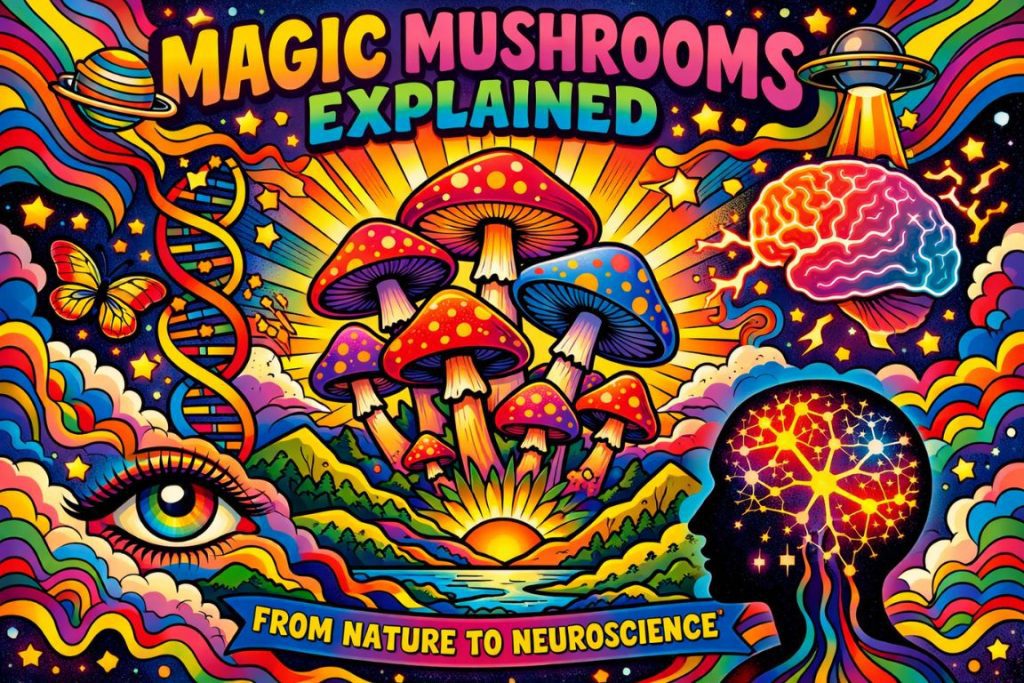
Magic Mushrooms Explained: From Nature to Neuroscience
Sep
Magic mushrooms, commonly associated with the compound psilocybin, have a long history rooted in nature and tradition. Today, they are also the focus of serious scientific research, as neuroscientists and psychologists work to understand how psilocybin interacts with the brain and alters perception.
This shift—from folklore to neuroscience—has reshaped how magic mushrooms are discussed in modern contexts.
What Are Magic Mushrooms?
Magic mushrooms are naturally occurring fungi that contain psilocybin, a psychedelic compound. Once ingested, psilocybin is converted in the body to psilocin, which is responsible for the compound’s psychoactive effects.
According to the National Center for Biotechnology Information (NCBI), psilocybin belongs to the tryptamine family and has a chemical structure similar to serotonin, a neurotransmitter involved in mood, perception, and cognition.
🔗 https://www.ncbi.nlm.nih.gov/pmc/articles/PMC8156539/
This similarity plays a major role in how psilocybin affects the brain.
From Traditional Use to Modern Research
For centuries, psilocybin-containing mushrooms have been used in ceremonial and spiritual practices, particularly in parts of Central and South America. These traditional uses emphasized introspection, meaning, and altered awareness.
Modern science has revisited psilocybin not to replicate tradition, but to study its effects under controlled conditions. Institutions such as Johns Hopkins Center for Psychedelic & Consciousness Research and Imperial College Londonare leading research into how psilocybin affects brain activity.
🔗 https://hopkinspsychedelic.org
🔗 https://www.imperial.ac.uk/psychedelic-research-centre/
How Psilocybin Affects the Brain
Psilocybin primarily interacts with serotonin 5-HT2A receptors, which are closely linked to perception and awareness. Research suggests that psilocybin may:
- Reduce rigid brain activity patterns
- Increase communication between brain regions
- Temporarily alter the sense of self and time
These changes help explain why experiences are often described as perspective-shifting rather than purely sensory.
Why Neuroscience Is Interested
From a neuroscience perspective, magic mushrooms offer a unique opportunity: they allow researchers to observe how the brain reorganizes itself when usual mental filters loosen.
Studies published in journals like Nature indicate that psilocybin can reduce the dominance of certain brain networks while increasing overall connectivity.
🔗 https://www.nature.com/articles/s41598-017-13282-7
This has made psilocybin a valuable tool for studying consciousness and cognitive flexibility.
Magic Mushrooms in Today’s Conversations
Today, magic mushrooms are discussed less as a cultural curiosity and more as a subject of scientific and psychological interest. Researchers are exploring what psilocybin reveals about:
- Perception and awareness
- Emotional processing
- The construction of meaning
This scientific focus has helped move the conversation beyond stigma toward understanding.
Key Takeaway
Magic mushrooms represent a bridge between nature and neuroscience. Through psilocybin, researchers are gaining insight into how the brain organizes perception, identity, and consciousness.
Understanding magic mushrooms isn’t about mystique—it’s about learning how the mind works when its usual patterns are temporarily reshaped.
Shop Today and Save
Canada wide shipping only
🛒 Shop Today – 20% off for blog readers
Promo Code: BLOG20
