
Psychedelics
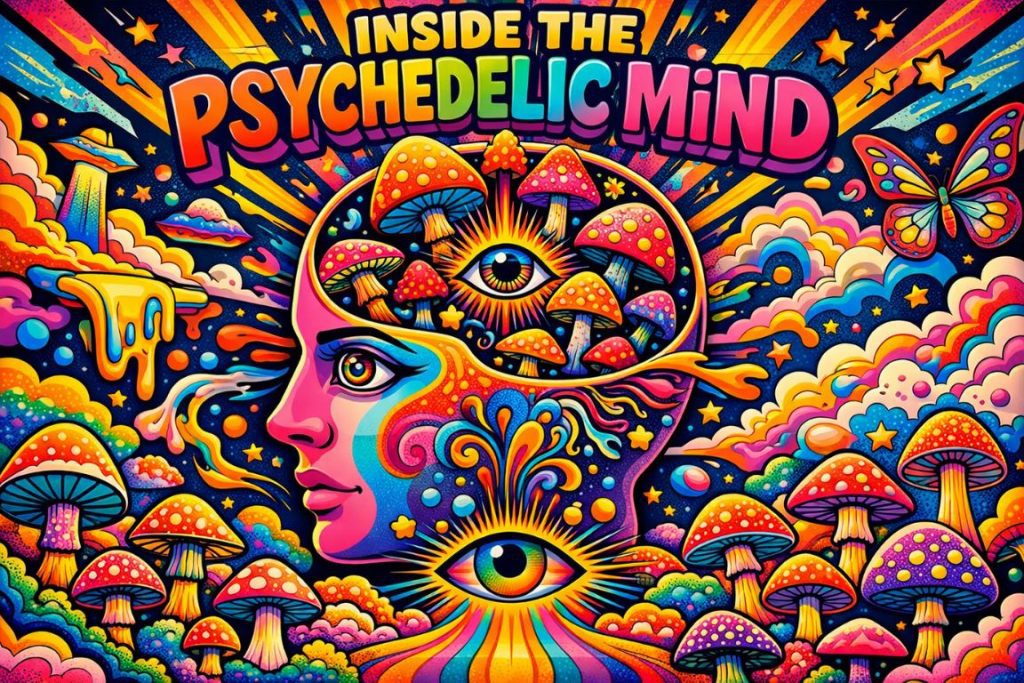
Inside the Psychedelic Mind
Oct
The phrase “psychedelic mind” is often used to describe experiences that feel deeply different from ordinary awareness. Rather than being chaotic or random, modern research suggests these states reveal important clues about how the mind organizes perception, emotion, and identity.
Scientists are increasingly interested in psychedelic states because they allow the study of the mind while its usual patterns temporarily shift.
The Mind as an Interpreter
Neuroscience shows that the brain does not passively receive reality—it actively interprets it. Sensory input, memories, expectations, and emotions are combined to create what we experience as “reality.”
Psychedelic research explores what happens when this interpretive system becomes more flexible. Studies suggest that during altered states, the brain’s usual filtering processes loosen, allowing perception and thought to feel more vivid and interconnected.
According to research summarized by the National Institutes of Health (NIH), this flexibility may help explain why psychedelic experiences are often described as insightful or perspective-shifting rather than simply sensory.
🔗 https://www.ncbi.nlm.nih.gov/books/NBK557813/
Changes in Brain Communication
One of the most consistent findings in psychedelic research is increased global brain connectivity. Instead of operating in rigid, separate networks, different regions of the brain communicate more freely.
Research from Imperial College London’s Centre for Psychedelic Research has shown reduced dominance of the default mode network—a system associated with self-focused thinking and internal narrative.
🔗 https://www.imperial.ac.uk/psychedelic-research-centre/
When this network quiets, people often report a reduced focus on habitual thought patterns and a greater sense of openness or observation.
The Observer Perspective
Inside the psychedelic mind, many people describe experiencing their thoughts and emotions from a distance. Rather than being absorbed by mental activity, they feel able to observe it.
Psychologists refer to this as metacognition—thinking about thinking. This observer perspective can make mental patterns more visible, which is why experiences are often described as introspective or clarifying.
The Johns Hopkins Center for Psychedelic & Consciousness Research studies this shift to better understand how awareness and self-perception are constructed.
🔗 https://hopkinspsychedelic.org
Emotion and Meaning
Another defining feature of the psychedelic mind is the strong link between emotion and meaning. Experiences often feel significant because emotional processing becomes more prominent, making memories, insights, and perceptions feel personally relevant.
Neuroscience suggests that emotion plays a key role in how experiences are encoded and remembered—helping explain why psychedelic experiences are often described as memorable or meaningful.
Why This Matters
Studying the psychedelic mind helps researchers understand:
- How perception is constructed
- Why thoughts can feel rigid or flexible
- How identity is maintained or altered
- How meaning arises from experience
These insights extend beyond psychedelics, influencing psychology, therapy, and consciousness research more broadly.
Key Takeaway
Inside the psychedelic mind, the brain appears more flexible, interconnected, and reflective. Rather than creating illusions, these states reveal how awareness normally operates—and how it can change.
Understanding the psychedelic mind is ultimately about understanding the human mind itself.
Shop Today and Save
Canada wide shipping only
🛒 Shop Today – 20% off for blog readers
Promo Code: BLOG20
